
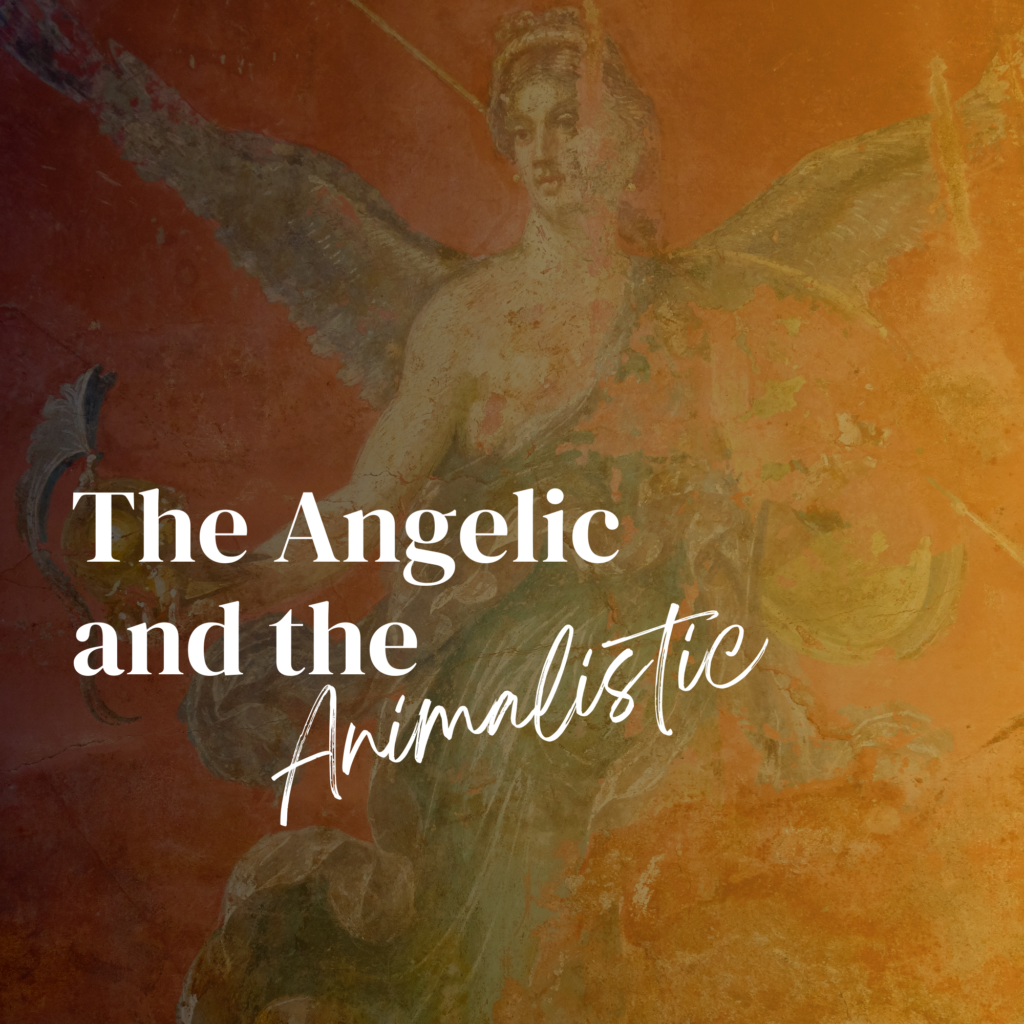
In the world of Dark Academia, the deadliest conflicts aren’t always fought with weapons; they’re fought in the space between our intellect and our instincts. We often talk about “falling” for someone, but in 16th-century philosophy, falling was a literal transformation. Below, I’m exploring the Great Chain of Being and how this ancient hierarchy creates the perfect, “suffocatingly seductive” environment for a story where the rungs of the ladder are about to snap.
A Study in Divine Tension
In the hallowed, dust-mote-filled halls of Sablegate Academy, the air often feels heavy with a specific kind of friction. It is the tension between the “High” and the “Low”—the divine grace of the celestial and the raw, unbridled heat of the infernal. This isn’t just a fantasy trope; it is a battle that has defined Western philosophy for nearly two millennia.
To understand the “Duality” Nina faces, we have to look back to the Scala Naturae, or the Great Chain of Being. Formalized during the Renaissance but rooted in the works of Aristotle and Plato, this concept theorised that every speck of creation had a fixed place on a vertical ladder.
At the top sat the Divine. Directly beneath were the Angels—beings of pure spirit, intellect, and light. Below them sat Humans, the “middle link” of the universe. We were believed to be the only creatures possessing both a divine soul and a mortal, animalistic body.
As Arthur O. Lovejoy famously explored in The Great Chain of Being (1936), this position was one of constant psychological warfare. To be human was to be pulled upward by the spirit and dragged downward by the “beast.”
Where do the demons and the fallen fit into this rigid hierarchy? In 16th-century thought, the “Fallen” were those who had deliberately stepped off their rung. By succumbing to pride or desire, they didn’t just lose their wings; they became “Animalized.”
While the Angel remains a creature of pure, cold intellect, the Demon or the Fallen Angel is often depicted as having regained a “primal” nature—claws, heat, and a visceral connection to the earth. This creates the perfect “Thrilling Fantasy” conflict:
- The Angel: Represents the unattainable, the sterile, and the disciplined.
- The Demon: Represents the “Id”—the primal instincts we are told to suppress, but which fuel our deepest desires.
In Sablegate Academy, Nina isn’t just choosing between “Good” and “Evil.” She is navigating the space between Divine Grace (the intellectual, soaring love of the celestial) and Primal Instinct (the grounded, breathless heat of the animalistic).
When a celestial being “descends” to Nina’s level, or a demonic entity tempts her to shed her academic discipline, they are breaking the Great Chain of Being. That breaking point is where the most “steamy” tension lives—in the moment we stop being “scholars” and start being “beings of instinct.”
Research & Further Reading
- Lovejoy, A. O. (1936). The Great Chain of Being: A Study of the History of an Idea. (Harvard University Press).
- https://www.inthemedievalmiddle.com/2013/09/natures-ladder-natures-vortex.html
- https://www.britannica.com/topic/Great-Chain-of-Being
Want to step deeper into the shadows?
My books always begin with a single spark of history or a forgotten piece of lore, but the most personal parts of that journey never make it into the final manuscript.
If you want to go beyond the pages, I invite you to join my newsletter. Subscribers get early access to these articles, plus my exclusive Behind the Veil notes—a personal look at the research, the late-night inspirations, and the secrets from my desk that shape the worlds I build.